Cherished
Parenting Services
Est. 2016
.png)
Spectra breast pumps Perth, Spectra breast pump stockist, breast pump hire Perth, Spectra S2, Spectra S1, flanges, lactation consultant Perth, Spectra valves, breast pump flange, Pumpin Pal Australia


Breast Pump Flange Sizing Guide
This information was last updated in March 2026 and reflects my most current, accurate guidance. If you come across any older content on my website or elsewhere with my name on it that appears different or contradictory, please know it is outdated. I would appreciate it if you could let me know where you found it so I can update or remove it.
Important information before you start reading
The information below may be quite different from what you’ve heard from other midwives or lactation consultants. This isn’t about being argumentative or contradictory. Please keep in mind that expressing and flange sizing has been my core business since 2016, and I have been helping mothers test flanges in person and virtually since 2020. I estimate I see 5–10 mothers every week specifically for flange sizing, and what I share here is based on consistent patterns I’ve observed and feedback I have had from clients, patients, and colleagues.
In fact, one friend and colleague calls me The Nipple Whisperer, haha, because of how accurately I can gauge flange sizes (I never guarantee 100% accuracy, but given how much experience I have now, I'm pretty confident in this advice).
Many health professionals simply do not have this level of hands‑on experience with flange sizing, and most rely on outdated information passed down from pump companies or colleagues. Learning how to do flange sizing is not part of the midwifery or IBCLC training (it is also not part of doctor training, so just because they have told you something different, does not mean they are right either).
Why does flange size matter
Most breast pumps come with 24mm flanges. I have heard 2 reasons for this - 60 years ago, when breast pumps were invented, they either based the sizing on the baby's mouth size when latched to a breast (which is about 24mm in diameter for a term baby) or the sizing is based on the dairy industry - ie, these are the sizes they use to milk cows...
If you’re using the 'standard' size and everything feels comfortable with good output, there’s no need to change anything, at the moment. I believe in 'if it is not broken you do not need to fix it'. But keep in mind that it could be reason your output drops off later or they could become increasingly uncomfortable, even after using the same size for months. You should always check your flange sizing if you start having issues.
Using the correct flange size can make a significant difference to:
-
Comfort
-
Milk flow
-
Overall expressing experience
I’ve seen many parents experience less discomfort and improved output immediately by simply finding the correct size. Increasing your overall output is not guaranteed though. But if you are struggling with output, and flange sizing is contributing to it, finding the correct size can help.
The three elements of flange sizing
Flange sizing is not just about measuring. And in fact, I strongly recommend not to base flange sizing on measuring alone. If another health professional has just measured and told you that is your size, it is probably not correct.
Flange sizing depends on:
-
How your nipples respond to vacuum
-
How the flange feels while you’re pumping
-
How your body responds (milk flow, comfort, letdown)
Before 2020, I also followed the common advice of measure the nipple and add 4mm.
Once I began allowing parents to test sizes in person, everything changed.
What I learned from testing with thousands of mothers
Most people prefer a flange size very close to their actual nipple size - not 4mm larger, not even 1-2mm bigger, and very often what appears to be even smaller than what I first thought.
Nipple size on a ruler often has no correlation to the size that works best during pumping, because this does not show how the nipple/breast responds when the pump is turned on.
Patterns I consistently see:
-
Most mothers need a lot smaller than they think or have been told
-
Some mothers have a “magic spot” where milk flows best, even if the flange looks smaller than expected. You should not be afraid to try smaller
-
Some nipples expand more under vacuum and need a slightly larger size (but we should not add millimetres to allow for swelling - as you'll see below, if the nipple is swelling after the pump has been on the flange is too big)
-
Some parents need to try a few sizes before finding the right one.
-
Sizing can change over time and may need reassessment.
Recently, I worked out some statistics based on flanges I have tested with people in person:
-
90% of mothers need 17mm or smaller
-
20% of mothers need 14mm or smaller
-
<1% of mothers need 21mm or bigger (I am so confident in this that I have stopped selling sizes bigger than 21mm to the public - if I determine that the person needs this size then I do have them available). I can count on 1 hand how many mothers I've seen who have truly needed bigger than 24mm (out of >2500...).
If you’ve been told you need 18–24mm or larger, it’s worth double‑checking.
Why I don’t recommend measuring nipples
Basing flange sizing on measuring alone is something I feel very strongly about. Almost every day I hear "The [midwife/LC] measured me and told me I need XX size". I usually respond with "OK, I would strongly recommend you come test them out in person [or send a video, if they are interstate]". If I could put money on the actual sizing being smaller to what the measurement has been I would not need to work again!
Measuring alone often leads to overestimating flange size. Which then leads to confusion or mothers thinking they need something else, rather than just a smaller size.
If someone has measured your nipples and given you a size based solely on that, it is probably not accurate.
The only reliable way to find the right size is to test different sizes, just like trying on shoes. I’ve lost count of how many times I’ve “eyeballed” a nipple and guessed wrong - the pump and actually using the flanges will tell the truth.
Signs your flange is too big
You may be using a flange that’s too large if:
-
Your nipple swells while expressing (including if it swells up and then stops moving)
-
Your breast loses contact with the flange (the nipple should 'plug' the hole)
-
Milk leaks out the bottom
-
You need high vacuum to get milk flowing
-
Letdown takes longer than a minute
-
Your breasts still feel full after 25+ minutes
-
It feels tight, but there’s still space around the nipple
Signs your flange is too small
A flange may be too small if:
-
The nipple does not move freely in the first minute (if it is fine to start with, swells up and then stops moving, it is too big)
-
The nipple cannot fit into the tunnel at all
Honestly, these are the only reasons to size up.
It is okay if the nipple touches the sides - as long as it moves freely.
I know we tell mothers that we do not want the baby just sucking on the nipple - but a baby latching directly is very different to a breast pump flange.
Sometimes 1–2mm too big feels worse than 3mm or more too big because a small amount of areola gets pulled in, causing a pinching sensation, and for it to feel 'too tight'. Ideally, almost no areola should be drawn into the tunnel.
I also strongly recommend not using inserts
Why?
This is another common issue I hear - "I'm using XX size but it feels like it is rubbing or pinching and I think I need bigger", then during the conversation I learn they are using inserts in 'regular' flanges. I usually help size them and we figure out the sizing was correct (or close to it).
The material inserts are usually made from can be 'sticky' - this can cause friction, which then leads to a rubbing or pinching sensation. This in turn leads the mother to think she needs bigger.
For most, regular (the hard, straight, plastic) flanges are completely fine. See the bottom of the page for more information on elastic nipples and different types of flanges.
My overall observations and tips
Based on thousands of fittings:
-
90% of mothers need 17mm or smaller - if you have not tried smaller, you probably need to
-
If your nipple moves in the flange to start with, but something feels wrong - you need to go smaller
-
Do not base sizing on measuring
-
Do not use inserts
If you need more help
If you’re struggling with expressing or breastfeeding, it is important to seek support from a qualified IBCLC and surround yourself with people who truly understand how it all works. Dispelling myths and misinformation are my areas of expertise - please get in touch to book a full breastfeeding consultant (or use the navigation above to go to 'Services').
I’m always happy to answer questions - please feel free to get in touch.
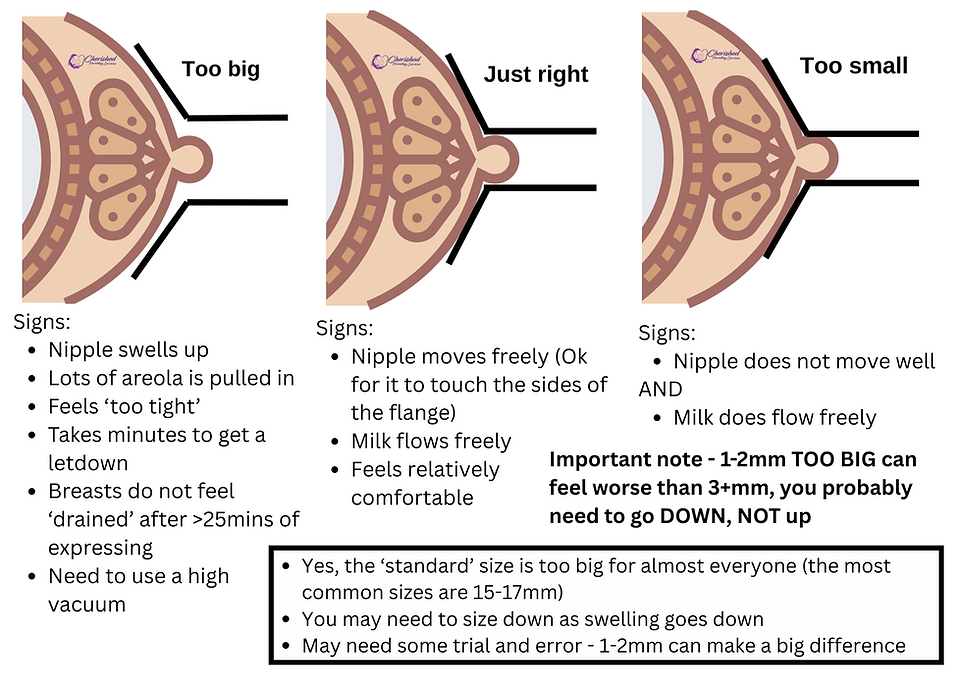
Summary of information (and you can download it to share with others or keep on hand to reference it)
Trying flange sizes (Perth & Australia/NZ options)
If you’re in Perth, you’re welcome to come and try different flange sizes in person. Please contact me to make a time (it is free)
If you’re interstate - or if you’d like to test sizes for a little longer - I offer a Flange Lending Service. You can borrow up to three different sizes to try at home before deciding what works best for you. Click here to order the service.
This service is available Australia and New Zealand wide. If you are overseas, please contact me for options
If you would like me to review your flange fit video
You can also send me a short video of you using your current flange. This helps me see how your nipple responds to vacuum and whether the size looks right or what size might be better*
Please follow these steps:
-
Start with your nipples at rest in the flanges. A side view works best, without hands‑free bras - they block the view.
-
Turn your pump on to massage/letdown mode (or the fastest mode) for a few seconds.
Important:
Please don’t send videos taken several minutes into a session. Once the nipple has swollen inside an incorrect flange, it doesn’t give me useful information.
You’re always welcome to contact me with any questions.
*I do not 100% guarantee being able to tell you the correct size, but I am usually right within 1-2mm.
Why measuring alone or 'pump for a few minutes then measure' can be misleading
Many guides suggest measuring your nipple after 5 minutes of pumping and adding 1–2mm.
In practice, this can be inaccurate because:
-
Nipples swell to match the flange you’re currently using, which artificially increases the measurement
-
It’s like trying on a T‑shirt over a jumper - you’ll always think you need a bigger size
-
Printable “cut‑out” sizing guides or nipple measuring "rulers" do not show how your nipple responds to vacuum, which is a crucial part of sizing
This is why testing sizes is far more reliable than measuring.
A note on “elastic nipples”
I often hear from people who believe they have “elastic nipples”, because their nipple reaches the end of the tunnel or touches it during pumping. Some have been told to buy specialty flanges such as Pumpin Pal or Lacteck. Or they think they need soft silicone because it is the hard plastic that is causing discomfort.
Over time, I’ve found that many people who think they have elastic nipples are actually using a flange that’s too big. Before spending money on alternative flange styles, it’s worth checking whether your current size is correct.
In most cases, regular (hard, straight) flanges work the best, when the size is right.
As always, please get in touch with any questions or for help.